|
|
Space Astro
|
Info for exoplanet "Axame-m"
| Scientific (actual) data |
|---|
| Name | TOI-2421 b |
| Planet status | Confirmed |
| Planet mass | 0.333 |
| Radius | 0.925 |
| Orbital period | 4.3474 |
| Semi major axis | 0.0543 |
| Inclination | 86.49 |
| Discovered | 2022 |
| Updated | 2023-07-11 |
| Tzero tr | 2458960 |
| Impact parameter | 0.409 |
| K | 37.8 |
| Temp calculated | 1534 |
| Publication | Published in a refereed paper |
| Detection type | Primary Transit |
| Mass measurement type | Radial Velocity |
| Radius measurement type | Primary Transit |
| Star name | TOI-2421 |
| Ra | 33.15° |
| Dec | -35.39° |
| Star distance | 327.3 |
| Star radius | 1.92 |
| Star temperature | 5645 |
| Wikipedia article | TOI-2421 b |
Back
| |
| Fictional info (?) |
|---|
| Axame-m |
| Hot gas giant |
| When viewed from Earth, this proximity to TOI-2421 means the planet can only be seen near the western or eastern horizon during the early evening or early morning.
It is radically different from Earth in other respects. It has the densest atmosphere of the known hot gas giants, consisting of huge amounts of ammonia.
It was the one of the first exoplanets visited by a spacecraft, and one of the first to be successfully landed on. |
| Atmosphere | Ammonia | 45% |
| Hydrogen deuteride (HD) | 32% |
| Hydrogen peroxide | 22% |
| Hydrogen chloride | 0.0019% |
| Nitrogen | 0.00018% |
| 0.0024 bar |
| 1 × Earth |
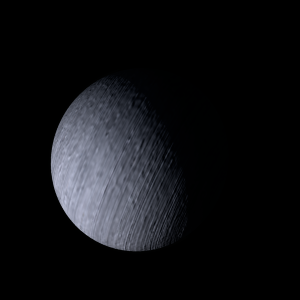 |
| Moon | Civim | Large almost round ice moon |
| Oqote | Small round ice asteroid |
| Ihato Jiro | Huge slightly egg-shaped gaseous moon |
| Google search for Axame-m |
|
Website by Joachim Michaelis
|
|
|
|