|
|
Space Astro
|
Info for exoplanet "Byayanyo"
| Scientific (actual) data |
|---|
| Name | TOI-1184 b |
| Planet status | Confirmed |
| Planet mass | 0.0214 |
| Radius | 0.215 |
| Orbital period | 5.74843 |
| Semi major axis | 0.056 |
| Discovered | 2024 |
| Updated | 2024-05-30 |
| Tzero tr | 2458680 |
| K | 3 |
| Publication | Published in a refereed paper |
| Detection type | Primary Transit |
| Mass measurement type | Radial Velocity |
| Radius measurement type | Primary Transit |
| Star name | TOI-1184 |
| Ra | 272.2° |
| Dec | 60.68° |
| Star distance | 58.59 |
| Star mass | 0.71 |
| Star radius | 0.69 |
| Star temperature | 4534 |
| Wikipedia article | TOI-1184 b |
Back
| |
| Fictional info (?) |
|---|
| Byayanyo |
| Small hot gas planet |
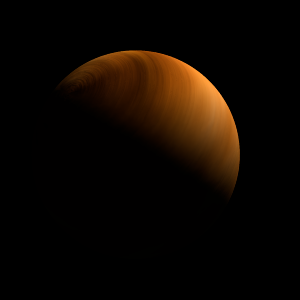
| The planet telescopically displays the complete range of phases, similar to Venus and the Moon, as it moves in its inner orbit relative to TOI-1184, which reoccurs over the so-called synodic period approximately every 151 days.
The ammonium hydrosulfide (NH4SH) has probably photodissociated, and the free neon has been swept into interplanetary space by the solar wind because of the lack of a ammonia layer. |
| Atmosphere | Neon | 68% |
| Formaldehyde | 20% |
| Ammonium hydrosulfide (NH4SH) | 11% |
| Ammonia | 0.00045% |
| Hydrogen peroxide | 3.0E-5% |
| Carbon dioxide | 1.0E-6% |
| Oxygen | 0% |
| 50 bar |
| 1.2 × Earth |
 |
| No known satellites |
| Google search for Byayanyo |
|
Website by Joachim Michaelis
|
|
|
|