|
|
Space Astro
|
Info for exoplanet "Caljulcli-idi"
| Scientific (actual) data |
|---|
| Name | PDS 70 e |
| Planet status | Confirmed |
| Planet mass | 34 |
| Semi major axis | 4.5 |
| Inclination | 49.5 |
| Discovered | 2025 |
| Updated | 2025-12-05 |
| Publication | Published in a refereed paper |
| Detection type | Astrometry |
| Star name | PDS 70 |
| Right ascension | 212.04° |
| Declination | -41.4° |
| Mag v | 12.233 |
| Star distance | 113.43 |
| Star mass | 0.76 |
| Star radius | 1.26 |
| Star sp type | K7 |
| Star age | 0.0054 |
| Star temperature | 4237 |
| Star detected disc | Imaging |
| Star alternate names | V* V1032 Cen, 2MASS J14081015-4123525 |
| Wikipedia article | PDS 70 e |
Back
| |
| Fictional info (?) |
|---|
| Suggested name | Caljulcli-idi |
| Planet type | Huge cold gas giant |
| When viewed from Earth, this proximity to PDS 70 means the planet can only be seen near the western or eastern horizon during the early evening or early morning.
As seen relative to the fixed stars, it rotates on its axis exactly five times for every three revolutions it makes around PDS 70.
The polar regions are constantly below 90°K (-183°C). |
| Atmosphere | Carbonyl sulfide | 39% |
| Argon | 28% |
| Helium | 25% |
| Hydrogen deuteride (HD) | 6.9% |
| Nitric oxide | 0.00064% |
| Atmospheric pressure | 80 bar |
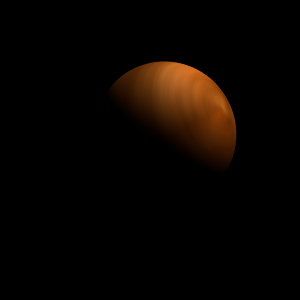 |
| No known satellites |
| Google search for Caljulcli-idi |
|
Website by Joachim Michaelis
|
|
|
|