|
|
Space Astro
|
Info for exoplanet "Ijibian-sur"
| Scientific (actual) data |
|---|
| Name | JADES-GS-BD-5 |
| Planet status | Confirmed |
| Planet mass | 40 |
| Discovered | 2023 |
| Updated | 2026-08-18 |
| Temperature (kelvin) | 403 |
| Publication | Published in a refereed paper |
| Detection type | Imaging |
| Mass measurement type | Theoretical |
| Right ascension | 53.08° |
| Declination | -27.84° |
| Star distance | 165 |
| Wikipedia article | JADES-GS-BD-5 |
Back
| |
| Fictional info (?) |
|---|
| Suggested name | Ijibian-sur |
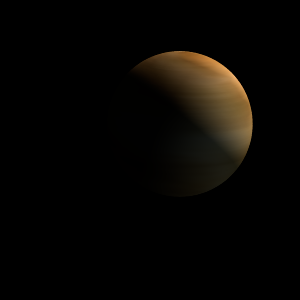
| Planet type | Huge cold gas giant |
| Having almost no atmosphere to retain heat, it has surface temperatures that vary diurnally more than on any other planet in its solar system, ranging from 55°K (-218°C) at night to 1085°K (812°C) during the day across the equatorial regions.
It was the one of the first exoplanets visited by a spacecraft, and one of the first to be successfully landed on.
The volume of water detected has been estimated to be equivalent to the volume of water in the Black Sea.
Because of its rapid rotation, the planet's shape is that of an oblate spheroid (it has a slight but noticeable bulge around the equator).
troublesome ride. |
| Atmosphere | Carbon monoxide | 97% |
| Carbon dioxide | 1.8% |
| Sulfur dioxide | 0.13% |
| Hydrogen deuteride (HD) | 0.032% |
| Methane | 0.0015% |
| Atmospheric pressure | 6 bar |
 |
| No known satellites |
| Google search for Ijibian-sur |
|
Website by Joachim Michaelis
|
|
|
|