|
|
Space Astro
|
Info for exoplanet "Prostis Ronban"
| Scientific (actual) data |
|---|
| Name | HD 93083 c |
| Planet status | Confirmed |
| Mass sini | 0.01611 |
| Orbital period | 9.6412 |
| Semi major axis | 0.0835 |
| Orbit eccentricity | 0 |
| Discovered | 2026 |
| Updated | 2026-05-02 |
| K | 1.73 |
| Publication | Published in a refereed paper |
| Detection type | Radial Velocity |
| Mass measurement type | Radial Velocity |
| Alternate names | GJ 1137 c |
| Star name | HD 93083 |
| Right ascension | 161.08° |
| Declination | -33.58° |
| Mag v | 8.3 |
| Star distance | 28.9 |
| Star metallicity | 0.15 |
| Star mass | 0.7 |
| Star sp type | K3 V |
| Star age | 6 |
| Star temperature | 4995 |
| Wikipedia article | HD 93083 c |
Back
| |
| Fictional info (?) |
|---|
| Suggested name | Prostis Ronban |
| Planet type | Warm planet |
| It is the coldest planetary atmosphere in its solar system, with a minimum temperature of 50°K (-223°C), and has a complex, layered cloud structure with carbon dioxide thought to make up the lowest clouds, and oxygen the uppermost layer of clouds.
It was the one of the first exoplanets visited by a spacecraft, and one of the first to be successfully landed on.
The largest moon, Lenemis Ioaofari, has a diameter greater than that of the planet Mars.
Planet is dangerous because of the unreliable primordial insects, the "Mepechal Ke", that feed alone while consuming plants. The Mepechal Ke are not similar to the Rondus-me but have 12 tentacles and vary in size from 3 to 7 cm. The Mepechal Ke can reproduce at temperatures from 30 to 80°C and sometimes extreme gravity which is common on this planet. |
| Estimated population | 900000 |
| Atmosphere | Oxygen | 88% |
| Carbon dioxide | 11% |
| Water | 0.34% |
| Methane | 0.027% |
| Atmospheric pressure | 0.7 bar |
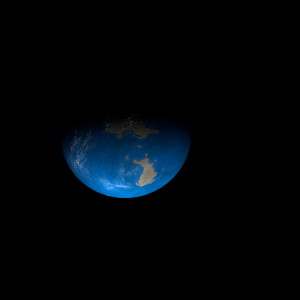 |
| Moon | Lenemis Ioaofari | Huge slightly egg-shaped rocky asteroid |
| Surtheus | Large potato shaped ice asteroid |
| Teaga Resope-beb | Huge slightly egg-shaped rocky comet |
| Google search for Prostis ronban |
|
Website by Joachim Michaelis
|
|
|
|