|
|
Space Astro
|
Info for exoplanet "Mebe'n"
| Scientific (actual) data |
|---|
| Name | DENIS J1403-3354 |
| Planet status | Confirmed |
| Planet mass | 47 |
| Discovered | 2025 |
| Updated | 2026-02-27 |
| Temperature (kelvin) | 2800 |
| Publication | Published in a refereed paper |
| Detection type | Imaging |
| Mass measurement type | Spectrum |
| Alternate names | DENIS J140329.6-335456, 2MASS J14032968-3354565 |
| Right ascension | 210.87° |
| Declination | -33.92° |
| Star distance | 121 |
| Wikipedia article | DENIS J1403-3354 |
Back
| |
| Fictional info (?) |
|---|
| Suggested name | Mebe'n |
| Planet type | Huge cold gas giant |
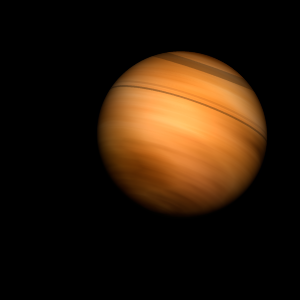
| It has the longest rotation period (445 days) of any planet in its solar system and rotates in the opposite direction to most other planets.
The polar regions are constantly below 297°K (24°C).
It may have had nitric oxide oceans in the past, but these would have vaporized as the temperature rose due to a runaway greenhouse effect.
A prominent result is the "great brown spot", a giant storm that is known to have existed for centuries since it was first detected by scanner.
Its north and south poles, therefore, lie where most other planets have their equators. |
| Atmosphere | Oxygen | 99% |
| Sulfur dioxide | 0.00096% |
| Nitric oxide | 5.0E-6% |
| Atmospheric pressure | 9 bar |
 |
| No known satellites |
| Google search for Mebe'n |
|
Website by Joachim Michaelis
|
|
|
|